Address
Sach Capital Limted
124 City Road
London
EC1V 2NX
United Kingdom
Work Hours
Monday to Friday: 9AM - 5PM

Address
Sach Capital Limted
124 City Road
London
EC1V 2NX
United Kingdom
Work Hours
Monday to Friday: 9AM - 5PM

Trading courses provide structured education that helps traders understand how markets work, manage risk effectively, and make consistent decisions under uncertainty. This guide explains what professional trading courses teach, why structured education matters, how experienced traders learn, and what to look for when choosing a high-quality trading course built for long-term skill development rather than shortcuts.
Trading courses exist because markets reward structure, discipline, and risk control rather than opinions or enthusiasm. Many traders learn this lesson only after costly mistakes. As a result, structured education plays a critical role in long-term development.
Professional trading education does not focus on predictions or quick wins. Instead, it teaches how markets work, how decisions should be made under uncertainty, and how risk must be controlled consistently. Without this foundation, even motivated traders often struggle to progress.
This article explains what trading courses are, how professional traders learn, why structured education matters, and what defines a high-quality programme. It also outlines the professional approach used by Sach Capital, a trading education provider focused on institutional-grade frameworks and long-term skill development.
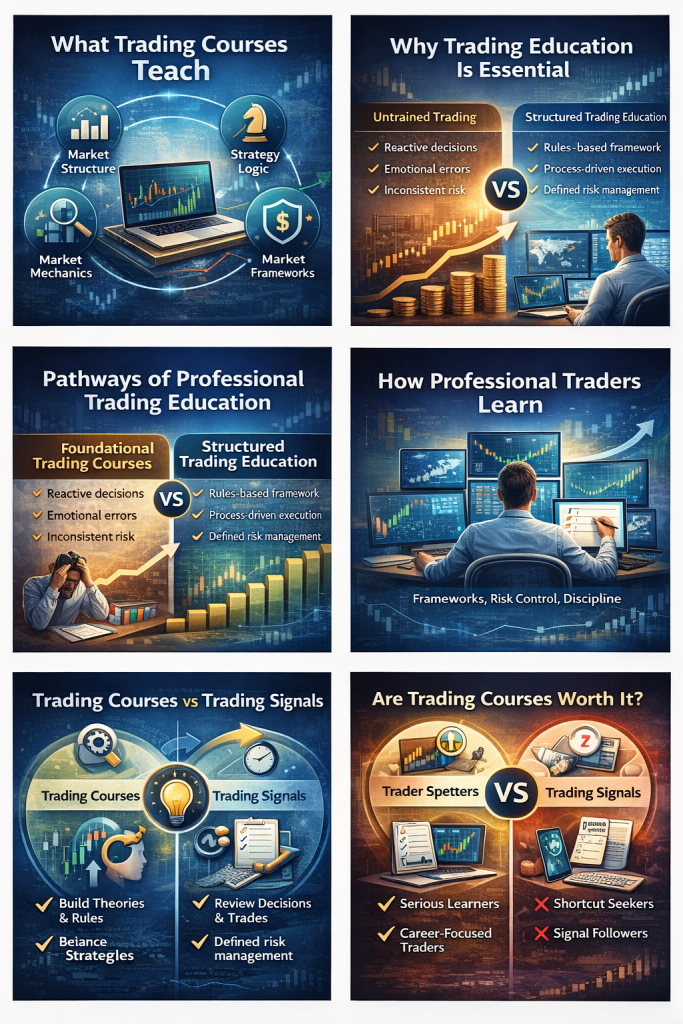
Trading courses are structured education programmes that teach traders how to approach financial markets in a disciplined and repeatable way. Rather than telling participants what to trade, these courses focus on how decisions are made and how risk is managed.
Importantly, professional trading courses aim to build independent thinking. They show traders how to analyse information, evaluate probability, and adapt as market conditions change.
High-quality trading courses teach how financial markets function and interact. They also explain concepts such as volatility, liquidity, and market structure. In addition, they focus heavily on risk management, capital preservation, and execution discipline. Most importantly, they introduce decision-making frameworks that traders can apply repeatedly.
The goal is skill transfer. Dependency is not the objective.
Professional trading education does not guarantee profits. It also does not provide signals, predictions, or personalised financial advice. Markets remain uncertain by nature. Education helps traders manage that uncertainty, but it does not remove risk.
Trading is a probabilistic skill. Without education, many traders rely on emotion, fragmented information, and trial and error. Over time, this approach often leads to inconsistent results and unnecessary losses.
Structured trading education shortens the learning curve because it provides clarity. Traders learn what matters, what does not, and how to evaluate decisions consistently.
Untrained trading often involves reactive decisions driven by headlines or price noise. In addition, risk tends to vary from trade to trade. Emotional responses to wins and losses are also common.
In contrast, structured trading education introduces rules-based frameworks. It also enforces predefined risk management and process-driven execution. Therefore, the difference is not intelligence or motivation. The difference is structure.
Different trading courses serve different stages of development. As traders progress, their educational needs change.
Foundational trading courses focus on market literacy. They explain how markets operate, introduce basic analytical concepts, and develop risk awareness. As a result, confusion is replaced with clarity.
Advanced trading courses build on existing knowledge. They focus on market structure, price behaviour, macro influences, and intermarket relationships. Consequently, traders develop deeper analytical skill and better context.
Professional trading programmes emphasise framework-based decision-making. They also prioritise consistency, repeatability, and risk-first execution. Therefore, these programmes suit serious traders who treat trading as a long-term skill rather than a short-term pursuit.
Professional traders do not rely on tips or predictions. Instead, they build frameworks that allow them to interpret information consistently across different market environments.
Learning happens through repetition. Concepts are applied, reviewed, refined, and repeated. Over time, this process builds confidence and discipline.
Institutional-style education prioritises process over prediction. It also values data over emotion and risk management before return. As a result, uncertainty becomes manageable rather than overwhelming.
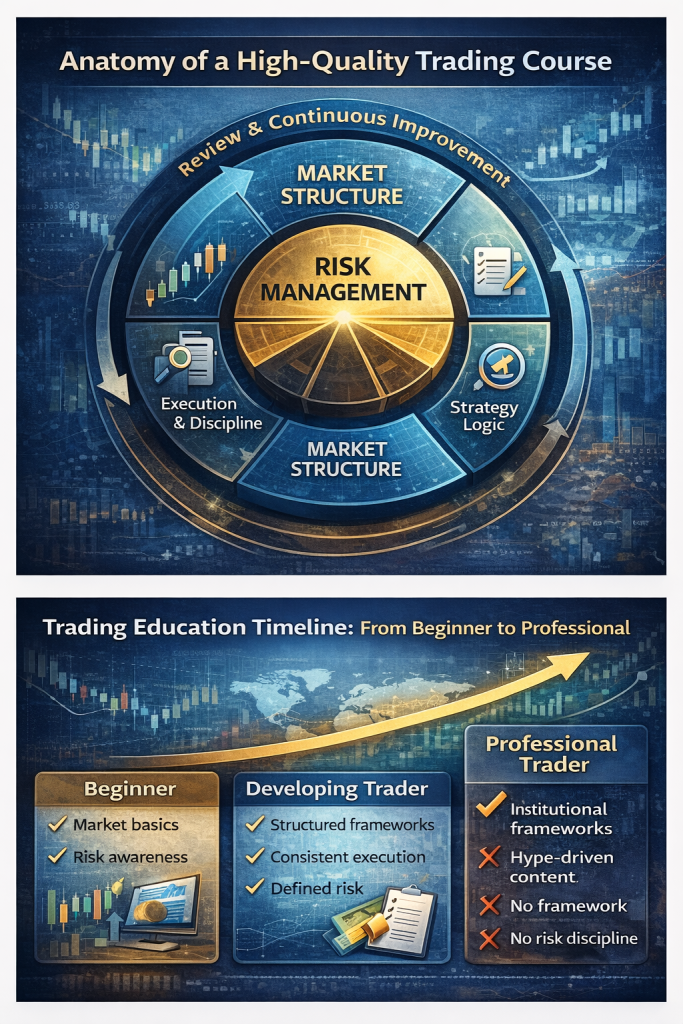
Not all trading courses deliver the same value. Certain features consistently separate high-quality education from marketing-led offerings.
A strong trading course follows a logical progression. Each concept builds on the last. Therefore, skills compound instead of remaining isolated.
Risk management must sit at the centre of every decision. Courses that treat risk as secondary overlook the most important element of trading. In contrast, professional education embeds risk into every framework.
High-quality courses rely on observable market behaviour. They avoid opinions and focus on repeatable logic. As a result, traders gain tools they can apply across different conditions.
Reputable providers communicate clearly. They position their offering as education only, include risk disclosures, and avoid performance promises. This transparency builds trust.
Trading signals outsource decision-making. Trading courses develop it.
Although signals may appear convenient, they create dependency. When market conditions change, traders often struggle without understanding. Education, however, builds independence.
Education transfers skill rather than instructions. Once traders learn frameworks, they can apply them across markets, instruments, and timeframes. Therefore, education scales far better over time.
Free resources can help initially. However, they often lack structure. Topics appear out of order, terminology varies, and gaps remain.
Structured trading courses solve this problem by offering cohesive learning paths, defined progression, and clear outcomes. Consequently, effort becomes focused rather than scattered.
When traders search for the best trading courses, they usually seek structure rather than shortcuts. They want professional education that helps them develop skill efficiently.
Trading courses are worth it for those who value disciplined learning, reduced trial and error, and consistent decision-making.
Trading courses suit serious learners, career-focused traders, and professionals who want structured development.
They are not designed for people seeking guaranteed results, signal followers, or those unwilling to commit to disciplined learning.
Online trading courses can work extremely well when designed properly. Structure and delivery matter more than format.
Effective online courses offer flexibility, repeatable access to material, and depth without geographic limits. As a result, learning becomes more accessible.
Effectiveness depends on clear structure, practical application, and defined learning objectives. Format alone does not create quality.
Sach Capital provides professional trading education built around institutional-grade frameworks and risk-first thinking.
The focus remains on structured decision-making, understanding markets across conditions, and maintaining discipline and consistency. Education is positioned as a long-term capability rather than a shortcut.
Sach Capital offers a range of structured trading courses designed for different experience levels and objectives. All courses are education-only programmes and are listed exclusively on the Sach Capital website. To explore the available trading courses, visit https://sachcapital.com/courses/.
There is no fixed timeline for learning trading. Foundational knowledge can develop relatively quickly. However, professional competence requires ongoing practice, review, and refinement.
Therefore, progress should be measured in skill development rather than speed.
One common misconception suggests that trading courses guarantee profits. They do not. Instead, they develop capability.
Another misconception assumes education only benefits beginners. In reality, structured learning also helps experienced traders refine their process.
Shortcuts prioritise speed but sacrifice resilience. Structured education builds traders who can adapt, manage drawdowns, and remain consistent as conditions change. Consequently, resilience separates short-term success from long-term participation.
The best way to learn trading professionally involves structured education focused on frameworks, risk management, and repeatable decision-making rather than tips or predictions.
Trading courses work when treated as education rather than guarantees. They build understanding, discipline, and skill that traders apply independently.
Online trading courses can be highly effective when they use strong structure, practical application, and professional frameworks.
Choosing a trading course reflects how seriously trading is treated as a skill.
Professional trading education does not remove uncertainty or effort. Instead, it provides structure, discipline, and clarity in a risk-driven environment.
For those seeking structured, institutional-style trading education, Sach Capital’s trading courses offer a professional pathway focused on long-term capability rather than short-term promises.
Explore the available courses at https://traders.mba/courses.
