Address
Sach Capital Limted
124 City Road
London
EC1V 2NX
United Kingdom
Work Hours
Monday to Friday: 9AM - 5PM

Address
Sach Capital Limted
124 City Road
London
EC1V 2NX
United Kingdom
Work Hours
Monday to Friday: 9AM - 5PM


White-label trading education enables forex brokers to offer professional, broker-branded education without building content, curricula, or delivery infrastructure in-house. When deployed as core broker infrastructure rather than a marketing add-on, education supports structured onboarding, improves behavioural consistency, strengthens execution and risk segmentation decisions, and enhances long-term platform value while preserving broker profitability and operational control.
White-label trading education allows forex and CFD brokers to offer professional, fully branded trading education under their own name without building content, curricula, or technology internally. The broker controls branding, positioning, access, and client experience, while the underlying educational framework, learning systems, and ongoing updates are delivered by a specialist provider.
In today’s brokerage landscape, education is no longer a marketing add-on. It has become core broker infrastructure. Structured trading education supports onboarding, improves demo-to-live conversion, stabilises client behaviour, and aligns with regulatory expectations around client understanding, appropriateness, and risk awareness. For brokers operating in competitive and highly regulated markets, education is one of the few scalable levers that improves client quality while strengthening operational control.
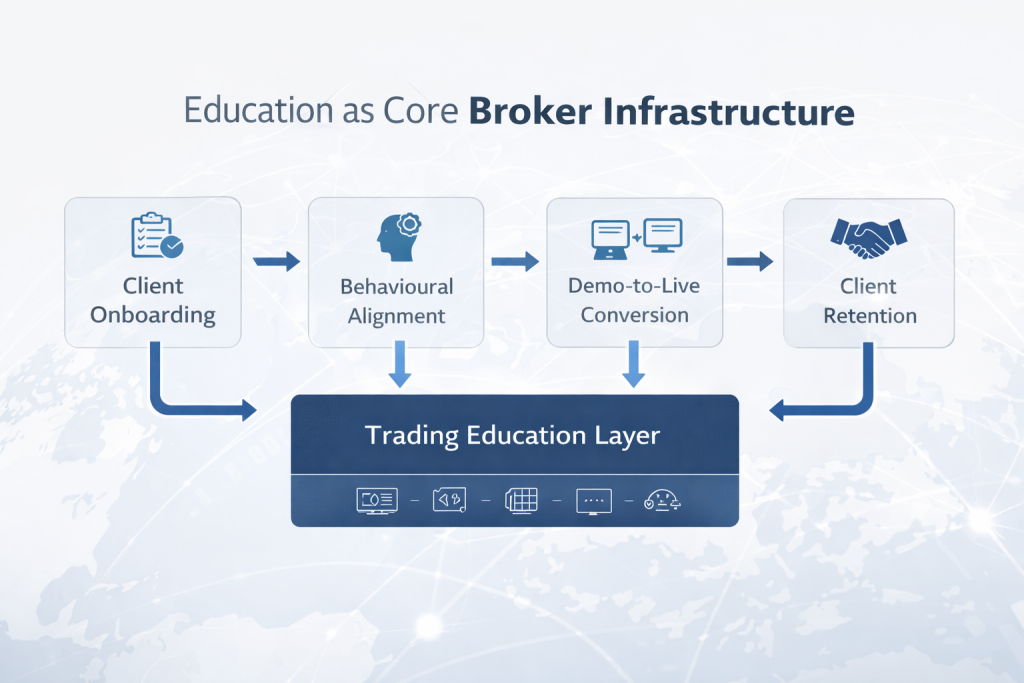
As illustrated above, trading education functions as a structural layer across the client lifecycle, supporting onboarding, behavioural alignment, conversion, and retention.
Most broker churn is not driven by spreads, platforms, or execution quality. It is driven by behavioural mismatch and unmet expectations. Many clients enter the market with unrealistic assumptions about leverage, probability, and risk. When those assumptions collide with market reality, disengagement follows quickly.
Structured trading education addresses this problem without altering outcome distributions. It reframes expectations, introduces process-driven thinking, and improves behavioural consistency. Brokers that deploy education strategically tend to see longer client lifecycles, reduced operational friction, and higher lifetime value, not because clients become more profitable, but because they behave more predictably.
The transition from demo to live trading remains one of the most fragile stages in the client lifecycle. Some clients move too quickly without preparation, while others never progress due to lack of confidence or understanding.
Education provides a structured bridge between these stages. By aligning learning milestones with onboarding, brokers can encourage progression based on behavioural readiness rather than time alone. This improves conversion quality, reduces early-stage churn, and creates more stable client cohorts.
Across jurisdictions, regulators increasingly focus on client understanding, appropriateness, and risk disclosure. While education is not a substitute for regulatory obligations, it acts as a powerful support layer. Outcome-neutral educational content helps clients understand how markets function, how risk behaves, and what realistic participation involves.
From a compliance perspective, education reduces misunderstandings, complaint risk, and expectation gaps, while remaining firmly non-advisory.
White-label trading education is a turnkey solution that brokers deploy under their own brand. It typically includes structured trading courses, learning pathways, supporting resources, and a learning management system that delivers content securely to clients.
To the end client, the education appears as an integrated part of the broker’s ecosystem rather than a third-party product, reinforcing trust and brand authority.
Brokers retain full control over branding, naming, access rules, and how education is positioned within the client journey. Education can be used for onboarding, retention, progression, or premium access, depending on the broker’s commercial model.
Curriculum design, content creation, instructional structure, platform maintenance, and ongoing updates are outsourced. This allows brokers to deploy institutional-grade education at scale without long development cycles or internal resource strain.
Developing education in-house introduces ongoing operational complexity. High-quality trading education requires subject-matter expertise, instructional design, production capability, and continuous updating as markets evolve. These are long-term commitments rather than one-off projects.
White-label solutions convert these challenges into predictable infrastructure. Brokers gain immediate access to mature educational frameworks without sacrificing focus on execution, risk management, or growth.
Internally produced or ad-hoc education often lacks coherence and depth. Professionally designed white-label programmes follow structured curricula that progress logically from foundational concepts to advanced application. This consistency enhances credibility and positions the broker as a serious, long-term platform rather than a transactional service.
White-label trading education can be deployed in weeks rather than months or years. This speed allows brokers to respond quickly to regulatory changes, competitive pressure, or expansion into new regions.
Signal-based offerings encourage dependency and short-term behaviour. When outcomes disappoint, dissatisfaction is often externalised toward the broker, increasing complaint risk and operational friction.
Education takes a fundamentally different approach. It develops understanding rather than reliance, supporting more consistent client behaviour over time and reducing volatility in client engagement.
Education aligns broker and client incentives around clarity, process, and understanding rather than outcomes. This alignment supports sustainable growth without undermining execution models or profitability.
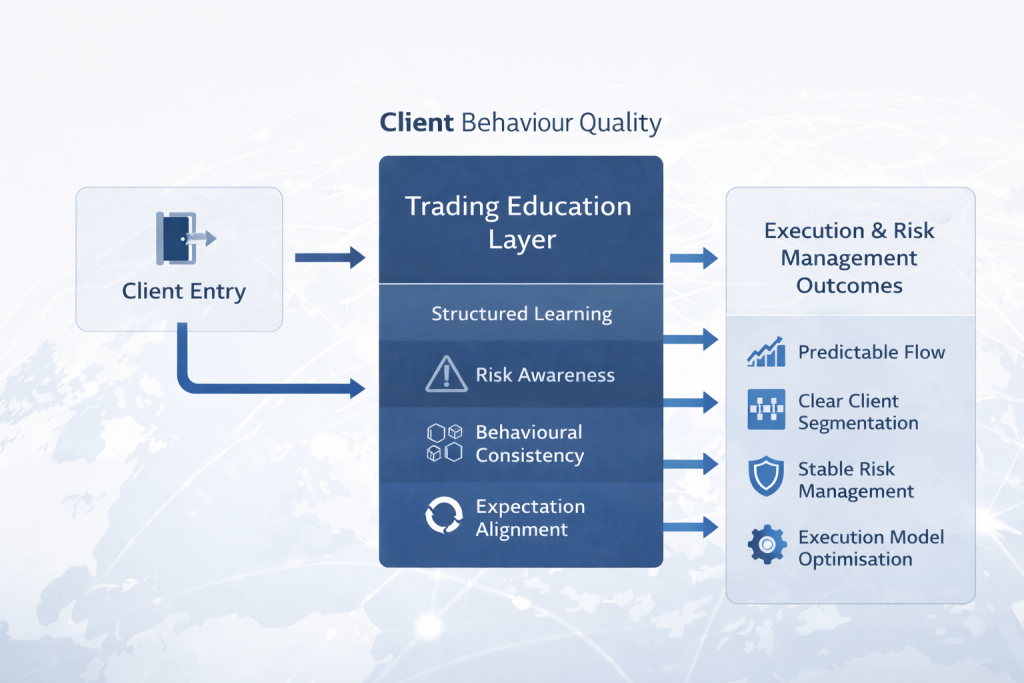
As illustrated above, structured trading education improves behavioural predictability, enabling clearer client segmentation and more stable execution decisions.
Modern brokers operate hybrid execution models designed to balance client flow, risk exposure, and profitability. In this context, the purpose of education is not to change client outcomes, but to improve client behaviour and classification.
Unprofitable broker relationships are rarely caused by clients losing money. They are driven by unpredictable behaviour, excessive leverage, rapid churn, disputes, and premature account closure. These patterns increase operational cost regardless of execution model.
Structured education improves behavioural quality without altering the fundamental distribution of trading outcomes. Clients remain speculative, but they become more consistent, better informed, and easier to segment. This allows brokers to identify which clients are suitable for internalisation, which require tighter risk controls, and which justify external hedging.
In practice, education strengthens execution decisions rather than undermining them. It supports cleaner internal flow, clearer client classification, and more stable revenue profiles across execution models.
Effective trading education is modular and progressive. Core topics typically include market structure, macroeconomic drivers, technical analysis, risk management, psychology, and execution planning. Content is sequenced to build competence gradually rather than overwhelm new participants.
Professional education focuses on analytical frameworks rather than tactics. It teaches how to evaluate markets, not what to trade. This outcome-neutral approach is essential for compliance, credibility, and long-term client development.
A robust learning management system underpins delivery. It must support scalability, multi-device access, secure client management, and progress tracking, while providing brokers with visibility into engagement and usage patterns.
Global brokers require education that can be deployed across regions. Language support, cultural sensitivity, and adaptability to different regulatory environments are essential for scalable white-label education.
Education aligns client expectations with market reality, reducing abrupt disengagement during periods of volatility.
Education filters behavioural noise rather than changing result distributions, improving manageability across the client base.
Education is a compounding asset. Longer engagement curves increase lifetime value without proportional increases in acquisition cost.
Clear educational boundaries reduce ambiguity, supporting smoother client management and fewer disputes.
Education supports onboarding, appropriateness assessments, and ongoing engagement while reinforcing professionalism and regulatory alignment.
Education provides differentiation beyond leverage and pricing, acting as a trust signal and stability layer.
Education standardises trader development and supports consistent assessment and progression frameworks.
Embedded education increases product stickiness and improves long-term user engagement.
Many brokers deploy education primarily to support core brokerage revenue by improving retention and engagement.
Advanced education modules can be positioned as premium offerings without compromising compliance.
Over time, education becomes part of the broker’s identity, reinforcing authority, trust, and long-term positioning.
Education should be deliberately mapped to each stage of the client journey, from onboarding to long-term engagement.
Progression should be driven by behavioural readiness rather than arbitrary timelines.
Education improves retention and engagement simultaneously, compounding value.
It is a broker-branded education solution that allows brokers to offer professional trading education without building content or infrastructure internally.
By partnering with a white-label trading education provider that supplies structured curricula, content, and delivery systems under the broker’s brand.
No. Education improves behavioural quality and client segmentation without altering outcome distributions or execution economics.
By making client behaviour more predictable and easier to classify and manage.
Yes. Education reinforces understanding, risk awareness, and clearer client communication while remaining non-advisory.
With a mature white-label solution, deployment typically occurs within weeks.
White-label trading education has evolved into strategic broker infrastructure. When deployed correctly, it improves behavioural quality, strengthens execution decisions, supports compliance, and stabilises revenue across client segments.
Education does not remove risk from the broker model. It makes that risk more measurable, more manageable, and more predictable.
For forex brokers, CFD brokers, prop firms, and fintech platforms seeking scalable growth without operational drag, white-label trading education is not a trade-off. It is a structural advantage.
If you are a forex or CFD broker evaluating how to strengthen client onboarding, improve behavioural quality, and deploy education as core infrastructure rather than a marketing add-on, a fully white-labelled solution offers a scalable path forward.
Sach Capital provides broker-branded trading education designed to integrate seamlessly into existing brokerage environments, supporting client lifecycle management, execution stability, and long-term platform value without operational complexity.
To explore how a white-label trading education solution can be deployed under your brand, view the full offering here: https://sachcapital.com/white-label-trading-education/
